
Uluç Ali Kılıç
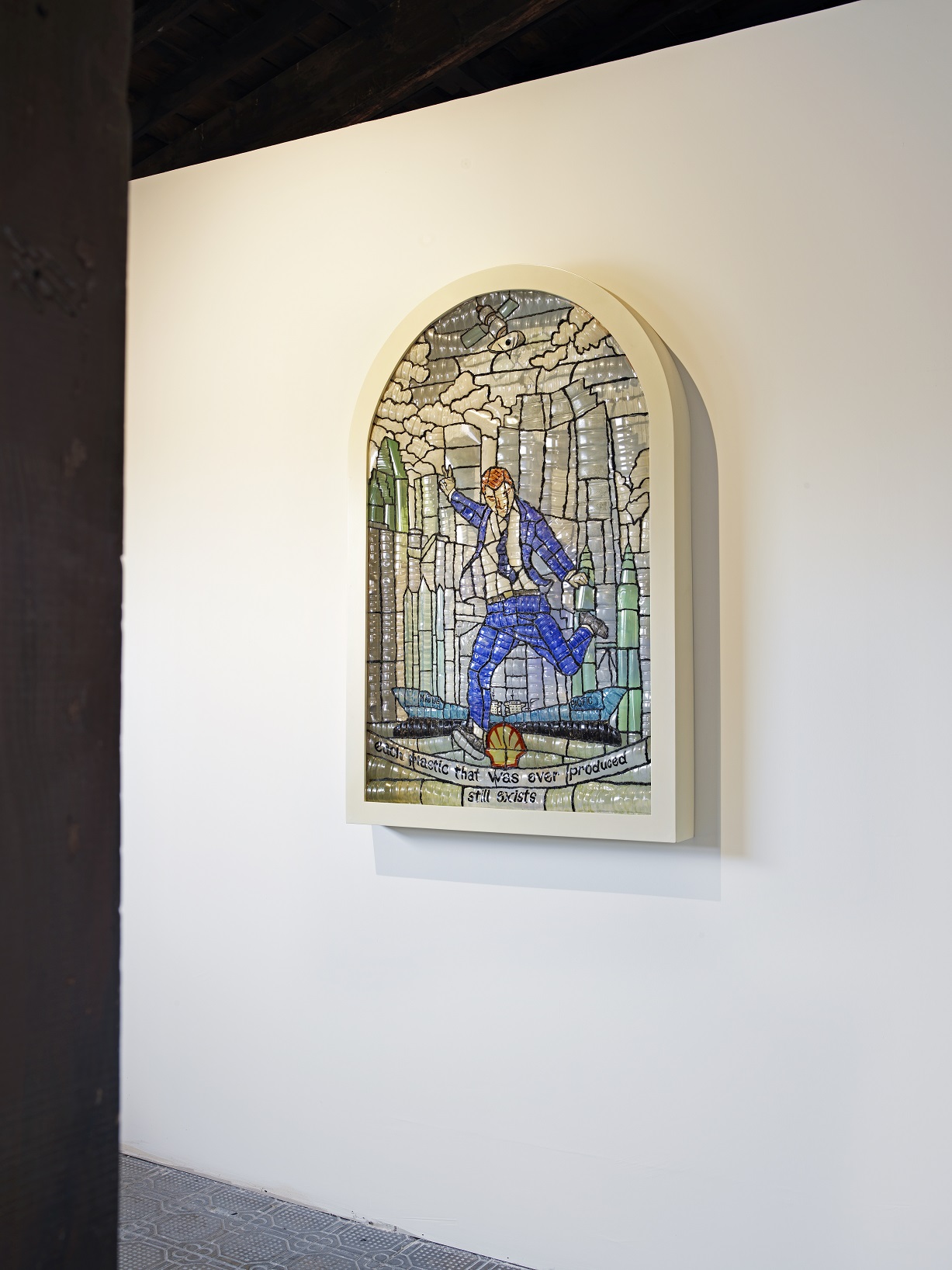
Petsistence, 2016, Plastic bottles, glass paint, wood, 117 x 73 cm
The central idea addressed in “Petsistence” is that plastic waste has become a major environmental problem. Although plastic is a recyclable material, the rate at which it is consumed does not correspond to the rate at which it is recovered and reintroduced into use. Unable to decompose naturally, this waste poses a threat to human health, ecological balance, and the environment. At the same time, plastic is one of the fundamental raw materials of modern civilisation and an indispensable component of contemporary technology. From eyewear and clothing to computer components, food storage, medical equipment, and the satellites sent into space, it is present at virtually every stage of production. Within this context, in this work—which may initially appear to be a conventional stained-glass window—traditional glass is replaced by plastic PET bottles, a material I describe as “the glass of the modern age.” This choice refers to qualities inherent in the material itself, such as durability, permanence, and its inability to disappear. The factual statement incorporated into the image, “each plastic that was ever produced still exists,” further reinforces this emphasis.
For centuries, stained-glass images have been used in religious places of worship to convey mystical, religious, and historical events. By filtering divine light through their surfaces, they added a spiritual dimension to the subjects they depicted. Through a certain repetition of this tradition, the work aims to enable viewers to establish an internal connection with its graphic narrative. In this way, it seeks to evoke within the psyche the question of what may be considered sacred.
When the work is examined formally, the world’s ten largest oil companies can be seen forming the background of the image as an immense wall that obscures the sky. At the horizon, two oil tankers symbolise the mountains of PET bottles in Madras, India, and the vast islands of plastic waste in the Pacific Ocean. An Asian businessman kicking at a corporate logo intervenes in the surrounding system through his identity as an ordinary white-collar worker. The fact that the figure carries out this intervention through a footballing gesture is intended to prompt further questions. At the top of the image, a satellite—the ultimate manifestation of technological advancement—observes everything taking place below. Produced by transforming, or “upcycling,” found materials, this new stained-glass work seeks, through its promise of indestructibility, to immortalise a contemporary problem facing present-day society.