

CANAN
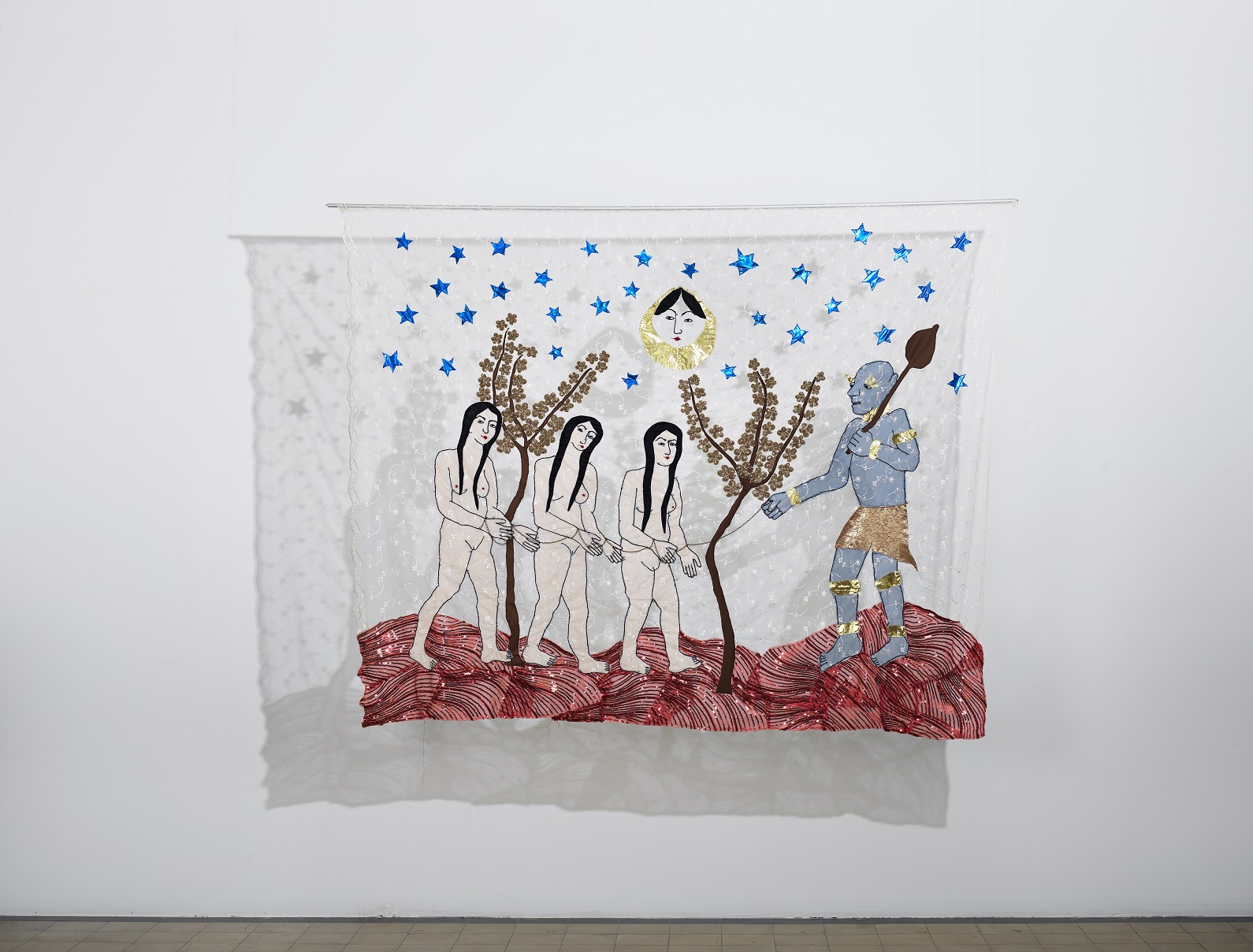
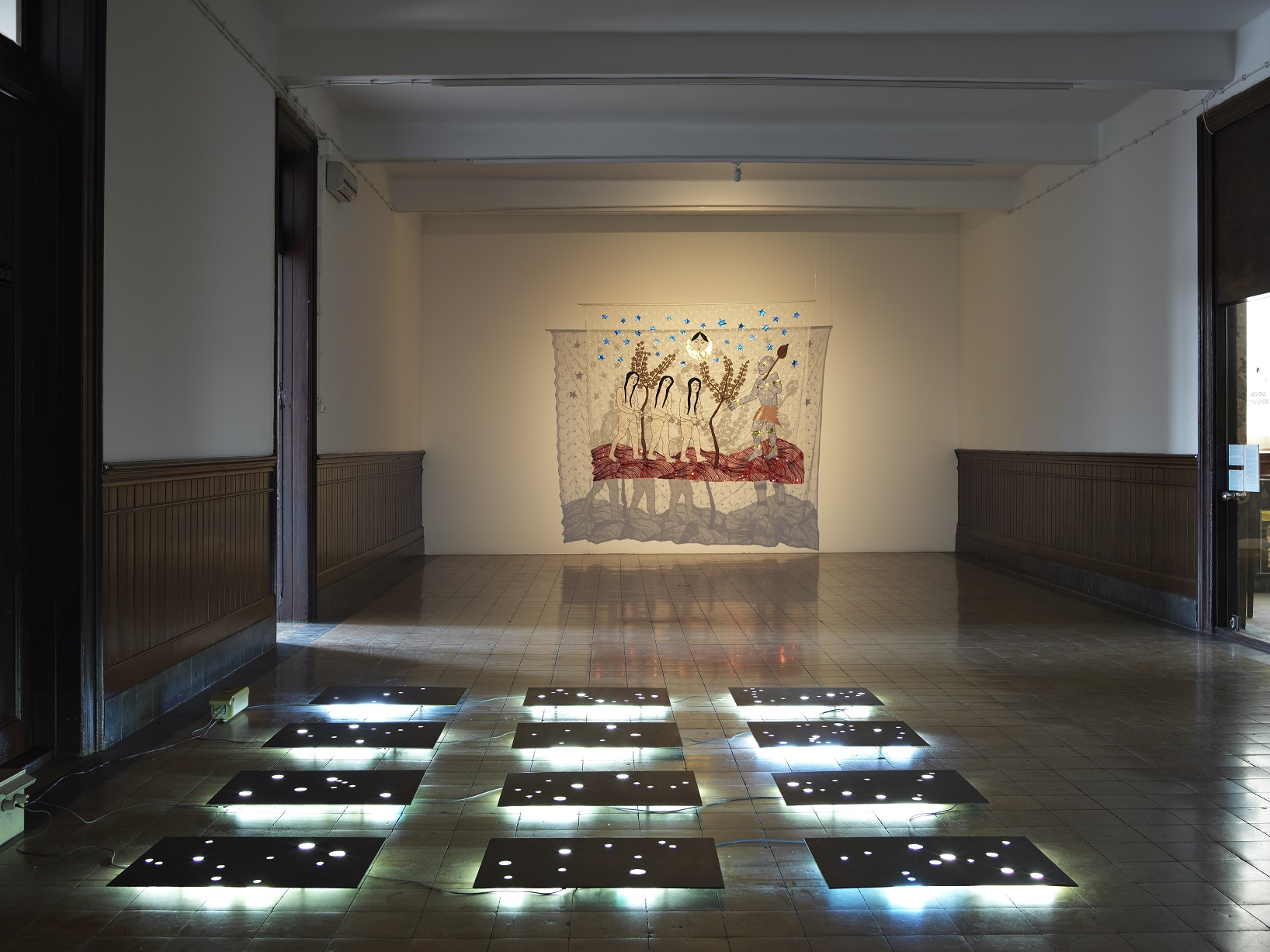
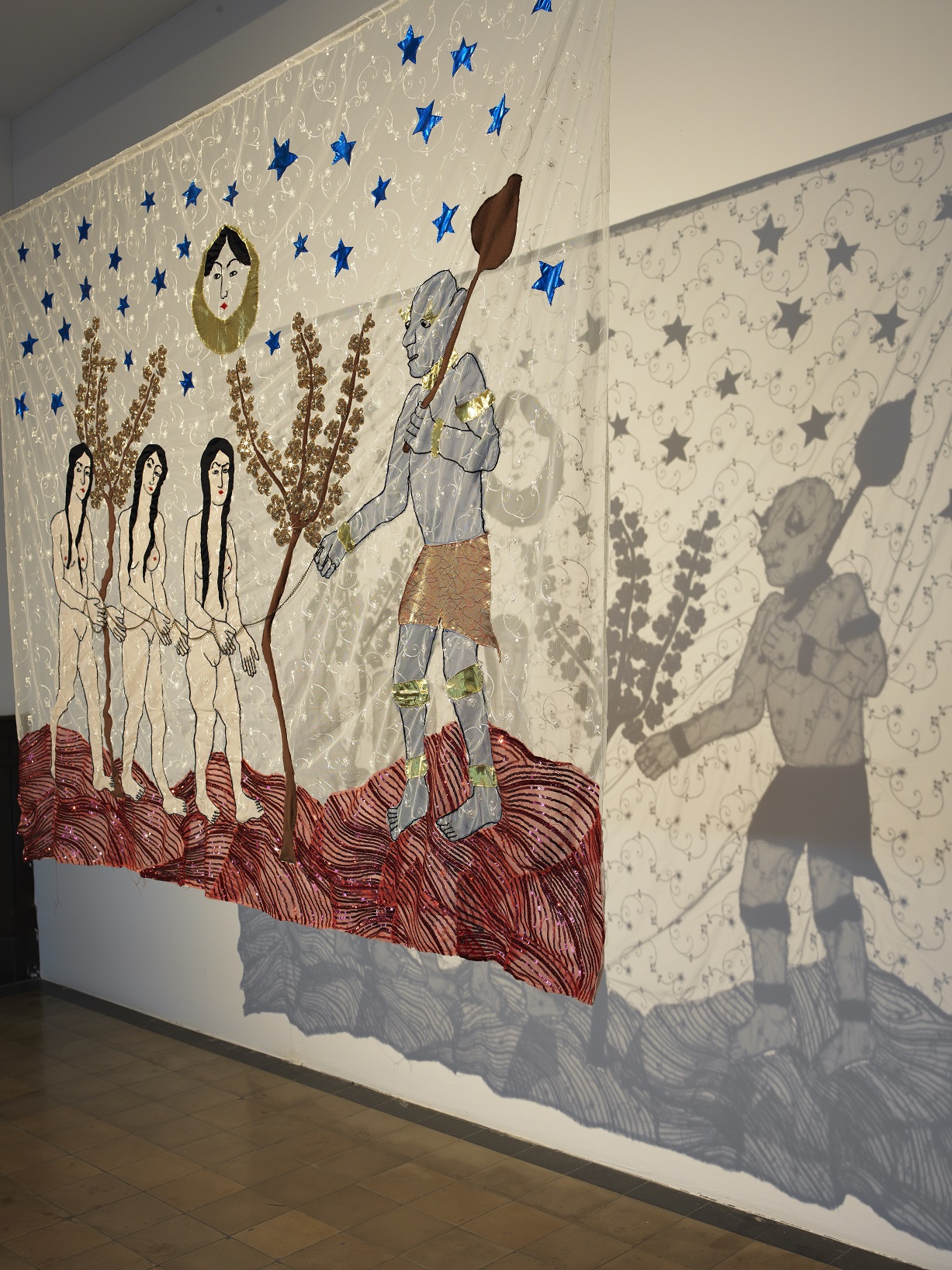
Moon, 3 Girls with Demon, 2015, fabric, sequins, and thread on tulle, 200 x 250 cm
In mythology, the Moon is most often personified as a goddess who assumes different functions. It is traditionally understood as feminine; for this reason, in ancient cultures the Great Goddess was perceived and represented in several distinct phases. Despite the many names attributed to her, she had three principal forms. The crescent moon represented the maiden, or the state of virginity and untouched purity. The full moon, with its swollen belly, symbolised motherhood. The waning moon, meanwhile, was depicted as the wise old woman.
In traditional astrology, the Moon is associated with memory. Everything we remember and experience is cast into the Goddess’s cauldron. The Moon therefore represents our emotions, habits, and, in brief, our personal unconscious. Some esoteric astrologers refer to the Moon as our past karma.
Jung, one of the founders of modern psychology, described the other side of ourselves contained within the personal unconscious as the “shadow.” The shadow is everything we could not become and the part of us that longs to do everything we have suppressed.
The emergence of the shadow that truly “belongs to us” is the emergence of our primitive, uncontrolled, and animalistic side. The shadow can also personify itself. When we dislike someone without any rational reason, we should suspect that the person possesses a quality that disturbs us because it also exists within ourselves.
In dreams, the shadow may appear as an inferior or highly primitive person, or as someone we dislike. It belongs to the personal unconscious and encompasses all the untamed desires and emotions that are incompatible with social standards and with our idealised image of ourselves. It consists of everything we are ashamed of and do not wish to know about ourselves. The narrower and more restrictive the society in which we live, the larger our shadow becomes.
Because the shadow is unconscious, it cannot be reached through conventional forms of education. It has remained essentially unchanged since infancy, when our behaviour was entirely instinctive. In all likelihood, it has remained the same since human beings first appeared on Earth, because the shadow is the natural—that is, instinctive—human being.
The shadow is also more than an element of the personal unconscious. It is personal insofar as it concerns our individual weaknesses and failures; however, because it contains an aspect shared by all human beings, it may also be understood as a collective phenomenon. The collective dimension of the shadow finds expression in figures such as the devil, the witch, and similar beings.
In choosing the word “shadow” to describe these aspects of the unconscious, Jung intended more than simply suggesting something dark and obscure. As he himself observed, there can be no shadow without the sun and, in the sense of the personal unconscious, no Shadow without the light of consciousness. The necessity of light and darkness, sun and shadow, belongs to the very nature of things. The shadow is unavoidable, and the human being cannot become whole without it.
Jung states that “the shadow is a moral problem that challenges the whole ego-personality.” Moreover, it is an important social problem that should not be underestimated. No one can confront the shadow without moral resolve and without reconsidering their ideas and standards. Jung implies that no transformation can occur without tolerance and love. Although tolerance and love have proven effective in the rehabilitation of those considered incompatible with society, they are attitudes that we rarely think to apply constructively to ourselves.
Every gender possesses both a persona and a shadow. The only distinction traditionally drawn is that a man’s shadow appears as another man, while a woman’s shadow appears as another woman. The unconscious complements the perspective of consciousness. A man’s unconscious contains a complementary feminine element, while a woman’s unconscious contains a masculine one. Jung called these elements the anima and the animus. Jung argues that a collective image of woman exists within the unconscious of man and that, through this image, he comes to understand the nature of woman. He calls this image the anima. According to Jung, the anima appears to derive from three sources: the collective image of woman inherited by a man; his experiences of women, formed through his relationships with them throughout his life; and the hidden feminine origin within himself.
Anima
The anima is intelligent, though not so intelligent that she cannot be overcome. Rather, “something strangely meaningful clings to her, a secret or hidden wisdom.
When a man suppresses his feminine essence, regards feminine qualities as inferior, and demeans or disregards women, this dark aspect is particularly likely to reveal itself. At times, figures may emerge with characteristics resembling benevolent or malevolent fairies, possessing the power to draw men away from their work and homes, much like the ancient Sirens—or their contemporary equivalents.
In mythology and literature, the anima frequently appears in the forms of the Goddess and the femme fatale—the fatal or destructive woman—“the face that launched a thousand ships,” La Belle Dame sans Merci, or figures from fairy tales such as the mermaid, the water nymph, or the demigoddess who demands that a man love her forever and, if he refuses, uses her seductive power to drag him underwater to his death.The anima may whisper absurd ideas into a man’s ear and prevent him from concentrating. She may poison his day by creating a vague and unpleasant sense of physical inadequacy, or haunt his sleep with seductive fantasies. A man who surrenders himself to his anima becomes the prey of uncontrollable emotions.
The animus in women corresponds to the anima in men. Like the anima, it appears to derive from three sources: the collective image of man inherited by a woman; her experiences of men, formed through her relationships with them throughout her life; and the hidden masculine origin within herself.
The Moon: Three Girls and a Djinn, when interpreted through these symbols, is a reflection of the “collective unconscious.” The Moon, described in the esoteric teachings mentioned at the beginning of the text as our past karma, represents—in Jungian psychology—the feminine energy within the collective unconscious; in other words, the “image of woman.”The three girls clearly embody the anima of masculinity contained within our collective unconscious. They represent the collective image of woman, the experience accumulated through women’s relationships with men throughout history, and the femininity that exists within every human being regardless of biological sex. In the work, this femininity appears to have been taken captive.The figure in the image that might be described as a devil, djinn, or demon represents the image of masculinity responsible for the captivity of femininity within the collective unconscious. At the same time, it represents the masculinity present within every human being. From this perspective, the masculine image defined as evil—the “demon,” “devil,” or “djinn”—embodies the sense of guilt buried within the collective unconscious.The shadow, which forms part of the installation, is the projection of the collective unconscious within our personal unconscious. The images of masculinity and femininity contained within our own untamed and uncontrolled unconscious are nourished by this realm.